TIG stainless steel welding ranks among the most accurate and dependable methods for joining stainless steel components. Whether your work involves custom motorcycle frames, exhaust systems, food-grade processing equipment, or architectural metal features, TIG stainless steel welding consistently produces clean, durable, and visually appealing welds that hold up over the long term. This complete guide walks you through everything you need to master TIG stainless steel welding—from choosing the right equipment and preparing your joints, to fine-tuning your technique and solving common issues. By the time you finish reading, you’ll have a solid grounding for achieving professional-grade TIG stainless steel welding results in your own shop.
What Is TIG Stainless Steel Welding?
TIG stainless steel welding is the application of Tungsten Inert Gas (TIG) welding specifically to stainless steel materials. In this process, a non-consumable tungsten electrode creates the arc, while an inert shielding gas—usually pure argon or an argon-helium blend—protects the weld pool from airborne contamination. With TIG stainless steel welding, the precision of heat control and the cleanliness of the gas shield work together to produce joints that are both strong and attractive. The final quality you achieve depends on careful machine calibration, the right choice of filler rod, and a steady, practiced hand throughout the weld.
Why Choose TIG for Stainless Steel Welding?
TIG stainless steel welding offers several distinct advantages over other welding methods. First, TIG provides exceptional control over heat input, which is critical when working with stainless steel due to its sensitivity to thermal distortion and carbide precipitation. Second, TIG stainless steel welding produces minimal spatter, reducing post-weld cleanup time. Third, the aesthetic quality of TIG stainless steel welding is unmatched—the characteristic “rainbow” coloration on a properly welded stainless steel joint is a hallmark of craftsmanship. For these reasons, TIG stainless steel welding is the preferred choice for applications where both strength and appearance matter.
Preparing Stainless Steel for TIG Welding:
Proper preparation is crucial for successful TIG stainless steel welding. Stainless steel forms a tenacious chromium oxide layer on its surface, which has a higher melting point than the base metal itself. For effective TIG stainless steel welding, this oxide layer must be removed from the joint area before welding begins.
Start by cleaning the surface with a dedicated stainless steel wire brush (never use the same brush on carbon steel, as this will cause contamination). For more thorough preparation, use a solvent such as acetone or isopropyl alcohol to remove oils, grease, and other organic contaminants. Grinding or filing the joint edges to remove the oxide layer and create a clean, bright surface is often recommended for TIG stainless steel welding projects where deep penetration is required.Joint fit-up is equally important in TIG stainless steel welding. Parts should be tightly fitted with minimal gaps, as excessive gaps make it difficult to maintain proper weld pool control and can lead to burn-through.
Essential Equipment for TIG Stainless Steel Welding:
Proper equipment selection is fundamental to successful TIG welding on stainless steel. Here are the key components you will need:
TIG Welding Power Source: For this process, you need a machine capable of DC (Direct Current) output with a high-frequency start. Inverter-based TIG welders are preferred for their precise current control and energy efficiency.
Tungsten Electrodes: This application typically uses 2% thoriated (red), 2% ceriated (grey), or 2% lanthanated (gold) tungsten electrodes. The electrode should be sharpened to a fine point for optimal arc stability.
Filler Rods: Selecting the correct filler metal is essential. Common choices include ER308L for 304 stainless steel, ER316L for 316 stainless steel, and ER309L for welding dissimilar metals.
Shielding Gas: Pure argon is the standard choice. For thicker sections, argon-helium blends can improve penetration and travel speed.
Gas Lens and Nozzle: Using a gas lens in your TIG torch improves gas coverage and allows for longer stick-out distances, which is beneficial when working in tight or hard-to-reach areas.
TIG Stainless Steel Welding Techniques:
Getting good at TIG stainless steel welding takes practice and close attention to the details. Here are the key principles to keep in mind:
Controlling Heat Input:
Stainless steel doesn’t conduct heat as efficiently as aluminum, but it still demands careful heat management in TIG stainless steel welding. Too much heat can cause warping, grain growth, and a reduction in corrosion resistance. Use a foot pedal or amperage control to adjust heat on the fly during TIG stainless steel welding, tapering off the current as you approach the end of the joint to avoid crater cracks.
Torch Angle and Travel Speed:
In TIG stainless steel welding, keep your torch at roughly 15 to 20 degrees off vertical. Feed the filler rod steadily into the leading edge of the weld pool. Your travel speed needs to be just right—moving too slowly makes the pool grow too large, while going too fast can lead to incomplete fusion.
Gas Coverage and Flow Rate:
Good shielding gas coverage is non-negotiable in TIG stainless steel welding. Set your flow rate between 15 and 25 CFH, adjusting for torch size and joint shape. Proper coverage during TIG stainless steel welding prevents sugaring—that dark, oxidized layer on the back of the weld that comes from atmospheric contamination.
Filler Metal Addition:
Welders have their own preferred ways of adding filler, but the “dip” method is the most common—dipping the rod rhythmically into the leading edge of the puddle. The quality of your TIG stainless steel welding ultimately comes down to consistent filler feeding and keeping a stable arc length throughout the weld.
Common TIG Stainless Steel Welding Problems and Solutions:
Even experienced welders encounter issues when performing TIG stainless steel welding. Understanding common problems helps with diagnosis and improvement.
Sugaring (Oxidation): This appears as a dark, grainy surface on the back side of the weld. It occurs when oxygen reaches the hot metal during TIG stainless steel welding. Solution: increase shielding gas flow, use a backing gas (argon purging), or install a gas diffuser on the back side.
Tungsten Inclusion: Small tungsten particles become trapped in the weld deposit. This happens when the tungsten electrode contacts the weld pool during TIG stainless steel welding. Solution: grind the tungsten to a proper point, maintain a consistent arc length, and avoid dipping the electrode into the pool.
Porosity: Gas bubbles trapped in the weld bead cause porosity. This is often the result of contamination on the metal surface or inadequate shielding gas flow during TIG stainless steel welding. Solution: thoroughly clean the material and verify gas flow rates and line integrity.
Heat Tint (Discoloration): While some coloration is normal, excessive heat tint indicates overheating during TIG stainless steel welding. Solution: reduce amperage, increase travel speed, or use smaller filler rods to manage heat more effectively.
Lack of Penetration: The weld does not fully fuse through the joint thickness. This can result from low amperage, improper technique, or insufficient pre-weld preparation. Adjusting settings and refining your TIG stainless steel welding technique usually resolves the issue.
TIG Stainless Steel Welding for Bike Frames:
Essential Equipment for TIG Welding Stainless Steel:
Proper equipment selection is fundamental to achieving strong, clean welds on stainless steel. Below are the key components you will need.
TIG Welding Power Source:
You will need a machine with DC output and high-frequency start capability. Inverter-based power sources are preferred for their precise amperage control and energy efficiency.
Tungsten Electrodes:
Common choices include 2% thoriated (red), 2% ceriated (grey), or 2% lanthanated (gold) tungsten. Sharpen the electrode to a fine point for stable arc performance.
Filler Rods:
Selecting the right filler metal is critical. ER308L is typically used for 304 stainless steel, ER316L for 316 stainless steel, and ER309L when joining dissimilar metals.
Shielding Gas:
Pure argon works well for most applications. For thicker material, adding helium to the mix can increase penetration and travel speed.
Gas Lens and Nozzle:
Using a gas lens improves shielding gas coverage and allows a longer stick-out, which is helpful when working in tight or awkward positions.
Post-Weld Treatment and Finishing:
Once TIG stainless steel welding is finished, proper post-weld treatment goes a long way toward improving both visual appeal and corrosion resistance.
Pickling and Passivation:
These chemical processes help restore the chromium oxide layer that gets depleted during TIG stainless steel welding. Pickling removes heat tint and surface scale, while passivation encourages the formation of a fresh, protective oxide film.
Mechanical Finishing:
For visible welds, blending or polishing can enhance the final look. Work your way through progressively finer abrasives, and be sure to use tools reserved exclusively for stainless steel—this avoids cross-contamination from carbon steel particles.
Inspecting the Weld:
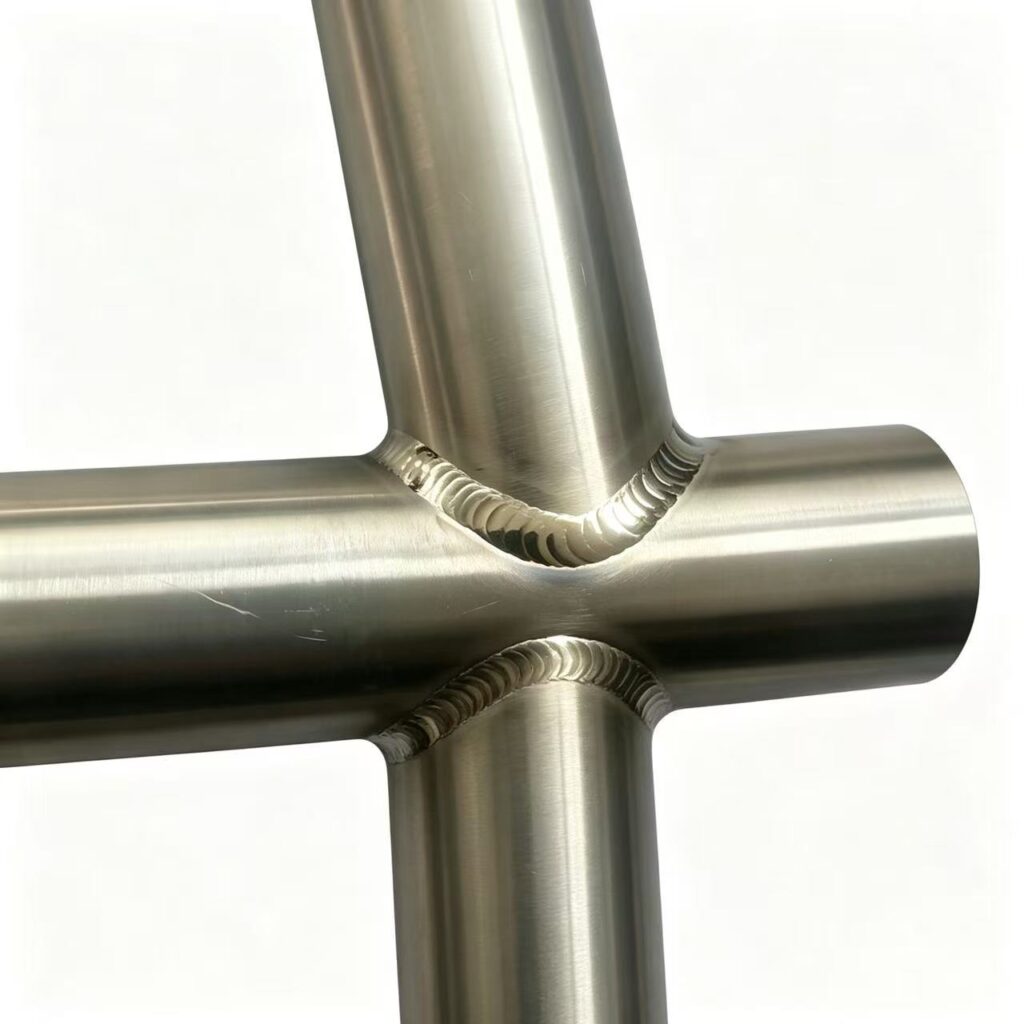
A well-executed TIG stainless steel welding joint should look smooth and uniform, with consistent bead width and a recognizable “stack of dimes” pattern. There should be no visible cracks, undercutting, or porosity.
Conclusion:
TIG stainless steel welding is a sophisticated process that rewards practice and attention to detail. Whether you are a professional fabricator or a dedicated hobbyist, mastering TIG stainless steel welding opens the door to high-quality work across a variety of applications. From custom bike frames to industrial components, the strength, cleanliness, and visual appeal of TIG stainless steel welding make it the gold standard. With proper equipment, careful preparation, and consistent technique, you can produce TIG stainless steel welding results that are both functional and beautiful.