Choosing the right welding process for your aluminum project isn’t just about operator preference or what’s always been done on the shop floor—it has a direct impact on part quality, production costs, and long-term reliability. At our facility, we hear the question of aluminum welding TIG vs MIG almost every day from engineers and procurement teams alike, and for good reason: these two processes produce distinctly different results, and making the wrong choice can be costly.
Aluminum is inherently difficult to weld. It forms an oxide layer almost instantly, conducts heat away much faster than steel, and is highly susceptible to distortion without careful control. That’s why, when we assess aluminum welding TIG vs MIG, the real question remains the same: Which process will give you the best outcome for your specific application?
In this guide, we cut through the technical jargon and compare TIG and MIG on aluminum from the perspective of a manufacturing partner—not just a welder’s point of view. Whether you’re new to aluminum welding or re-evaluating your current approach, this side-by-side comparison will provide the clarity you need to make a confident decision.
MIG Welding Aluminum: High-Speed Production Without Compromise
When the discussion turns to aluminum welding TIG vs MIG for high-volume production, MIG consistently emerges as the front-runner. Wherever deposition speed and throughput take priority, MIG delivers outstanding performance—particularly when paired with the right setup and technique.
What MIG Brings to Your Parts:
Higher Output:
In the aluminum welding TIG vs MIG debate, MIG lays down weld metal at a significantly faster rate—often triple that of TIG. For large production orders, that advantage translates directly into shorter turnaround times and lower cost per unit.
Stronger Fusion on Thick Sections:
The high-energy arc provides deep penetration, making MIG a solid choice for heavier gauges. For anyone weighing aluminum welding TIG vs MIG on plate thicknesses above ¼″, MIG offers the joint strength required for structural, load-bearing applications.
Repeatable, Reliable Quality:
With semi-automated or fully automated MIG systems, weld consistency stays high across long seams and large batch runs—a clear edge in the aluminum welding TIG vs MIG equation for production-floor efficiency.
When MIG Fits Your Project Best:
- Material thickness exceeds 3/16″ (4.8 mm)
- Large structural parts that call for long, continuous welds
- High-volume runs where cost control is a priority
- Applications where a small amount of post-weld cleanup is acceptable
If your project matches these conditions, your aluminum welding TIG vs MIG decision becomes much clearer—and MIG is likely your answer. vs MIG decision leans clearly toward MIG.welding aluminum decision leans clearly toward MIG.
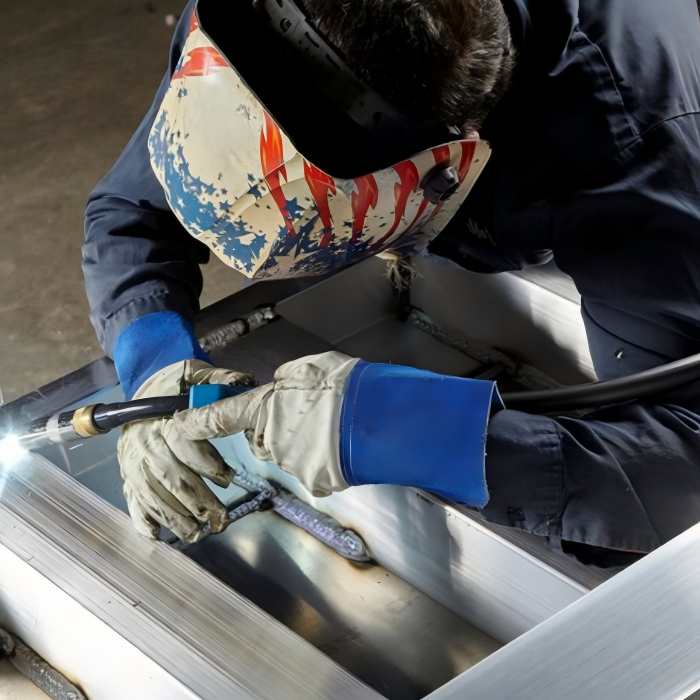
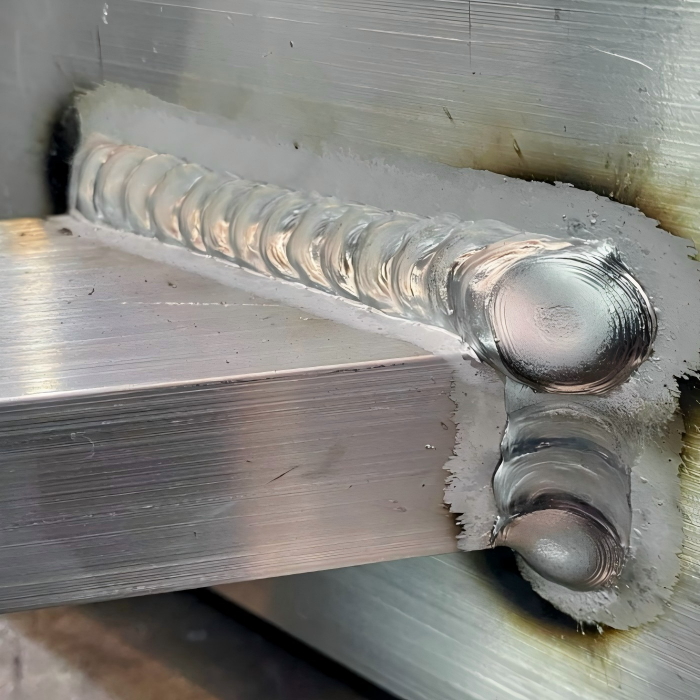
The Core Technical Difference: What’s Actually Happening at the Arc?
Understanding the mechanisms behind TIG and MIG is essential to any meaningful aluminum welding TIG vs MIG comparison. These fundamentals directly affect the appearance, strength, and cost of your finished parts.
| Aspect | MIG (Metal Inert Gas) | TIG (Tungsten Inert Gas) |
|---|---|---|
| How It Works | A continuously fed wire acts as both electrode and filler metal. | A non-consumable tungsten electrode creates the arc; filler is added manually. |
| Heat Input | Higher overall heat into the base material. | Precise, localized heat with independent pedal control. |
| Deposition Rate | Fast — up to 3x faster than TIG. | Slow — meticulous, controlled deposition. |
| Operator Skill | Moderate (modern pulse machines assist significantly). | High (requires significant experience and coordination). |
| Typical Applications | Structural frames, heavy equipment, marine components. | Custom fabrications, aerospace, automotive, thin-wall enclosures. |
This is the foundation of any aluminum welding TIG vs MIG discussion. The choice ultimately depends on what you prioritize: speed and volume, or precision and aesthetics.
TIG Welding Aluminum: Precision, Aesthetics, and Structural Integrity
On the other side of the MIG vs. TIG welding aluminum spectrum sits TIG—the benchmark for quality in aluminum fabrication. When a part demands impeccable appearance, minimal distortion, or critical structural performance, TIG is often the preferred process.
What TIG Delivers for Your Product:
Superior Aesthetics:
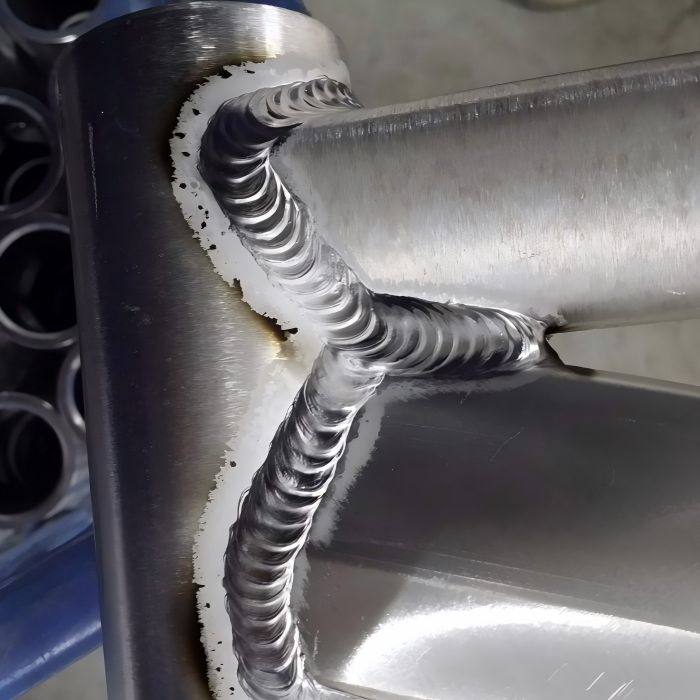
The stack of dimes weld profile is the hallmark of premium craftsmanship. In the Aluminum Welding TIG vs. MIG welding aluminum debate, TIG wins unequivocally on appearance—critical for consumer-facing products and architectural elements.
Minimal Heat Distortion:
Precise heat input means less warping. For thin-wall enclosures and tight-tolerance parts, this factor alone can decide your MIG vs. TIG welding aluminum choice.
Superior Metallurgical Properties:
Lower overall heat input preserves the strength of the heat-affected zone (HAZ), resulting in stronger, more durable finished parts.
Zero Spatter:
No spatter means no post-weld grinding—reducing secondary processing time and cost.
When TIG Is the Right Choice for Your Project:
- Material thickness is less than 1/8″ (3.2mm)
- Appearance and surface finish are critical
- Parts require tight dimensional tolerances with minimal distortion
- The application involves food-grade, medical, or aerospace standards
For these scenarios, the MIG vs. TIG welding aluminum decision points firmly toward TIG.

The Golden Rule for Your Project: Production vs. Precision:
Here is our straightforward recommendation framework—built from hundreds of aluminum projects we’ve delivered across industries. It distills the aluminum welding TIG vs MIG decision into two clear paths:
Choose MIG if your project involves:
- Heavy equipment frames, trailers, or marine structures
- Batches of 100+ units where per-part cost is a critical factor
- Material thickness consistently above 3/16″
- Welds longer than 12 inches per joint
→ View our MIG aluminum welding capabilities
Choose TIG if your project involves:
- Custom enclosures, frames, or visible architectural components
- Thin-wall tubing or sheet metal under 1/8″
- Applications where appearance is a selling point
- Parts requiring X-ray quality or zero-porosity welds
- Low to medium volume with high complexity
→ View our TIG aluminum welding capabilities
This framework resolves most aluminum welding TIG vs MIG questions we receive. If your project falls between these categories, read on—Pulse MIG offers a compelling middle ground.
Side-by-Side Comparison: What Matters for Your Parts:
When evaluating a manufacturing partner, these are the metrics that should guide your MIG vs. TIG welding aluminum decision:
| Factor | MIG | TIG |
|---|---|---|
| Ideal Material Thickness | > 3/16″ (thicker sections) | < 1/8″ (thin sections) |
| Relative Cost per Part | Lower for high volumes | Higher (slower process) |
| Lead Time | Faster for large orders | Slower for complex/small orders |
| Weld Appearance | Good (pulse MIG approaches TIG quality) | Excellent (stack of dimes finish) |
| Distortion Risk | Higher on thin materials | Low across all thicknesses |
| Post-Processing Needs | Moderate (spatter removal) | Minimal (ready for finishing) |
This side-by-side view is the centerpiece of any practical MIG vs. TIG welding aluminum guide. Use it as your reference when reviewing project requirements.
Why Pulse MIG Is Bridging the Gap?
If you’ve been exploring the aluminum welding TIG vs MIG question, chances are you’ve come across Pulse MIG. This technology has changed the game, offering a hybrid solution that didn’t exist before.
What it brings to your parts:
- Cuts spatter by up to 80% compared to conventional MIG
- Enables welding on thinner gauges (as low as 18 gauge) without risk of burn-through
- Produces weld appearance close to that of TIG
- Keeps travel speeds well above what TIG can achieve
Our perspective:
In our shop, we turn to Pulse MIG for jobs that fall between high-output production and fine-precision work. It doesn’t replace the need to understand the core aluminum welding TIG vs MIG principles, but it does give us a useful third option for the right applications.
Real-World Cost Impact: A Manufacturing Partner’s Perspective
To illustrate how the MIG vs. TIG welding aluminum decision affects your bottom line, let us examine two real scenarios:
Scenario 1: 100 Units of a Heavy Equipment Frame (1/4″ Aluminum)
| MIG Route | TIG Route | |
|---|---|---|
| Estimated Production Time | 2.5 hours per unit | 8.5 hours per unit |
| Total Labor Cost | Lower | 3x higher |
| Per-Unit Cost | Most economical | Significantly higher |
| Our Recommendation | MIG is clearly the right choice here | — |
→ See similar heavy-frame projects we have delivered
Scenario 2: 50 Units of a Custom Display Frame (1/16″ Aluminum)
| MIG Route | TIG Route | |
|---|---|---|
| Distortion Risk | High — requires jigs and rework | Low — controlled heat input |
| Scrap Rate | ~15-20% | < 1% |
| Post-Weld Finishing | Extensive grinding required | Minimal — ready for anodizing |
| Our Recommendation | TIG delivers better total value here | — |
→ See similar precision frame projects we have delivered
These scenarios demonstrate why the MIG vs. TIG welding aluminum decision is never one-size-fits-all. The right choice depends entirely on your specific project parameters.
Quality Assurance: What We Guarantee for Every Weld
No matter which direction you go in your aluminum welding TIG vs MIG decision, every weld that leaves our facility is held to strict quality standards. Our capabilities cover:
Dimensional Inspection: CMM and optical measurement systems for verifying tolerances
Non-Destructive Testing: Options include dye penetrant, X-ray, and ultrasonic inspection
Surface Finish: Pre-weld cleaning and post-weld preparation to support anodizing or painting
Material Traceability: Full documentation ensuring alloy verification at every stage
Conclusion: Let‘s Find the Right Process for Your Parts
There’s no one-size-fits-all answer to the aluminum welding TIG vs MIG question—only the right fit for your particular application. The best choice depends on factors like material thickness, production volume, cosmetic requirements, and budget constraints.
What we promise you:
We don’t apply a standard welding process across all jobs. Instead, we review your drawings, study how your part will be used, and then recommend—and carry out—the process that gives you the optimal balance of quality, cost, and turnaround time. Whether that means high-speed MIG for your large-scale production or precision TIG for your custom prototype, we have the skills and equipment to make it happen.
The aluminum welding TIG vs MIG choice is a critical one. We’re here to make sure you choose wisely.
Ready to discuss your aluminum welding project?
Our engineering team is standing by to evaluate your drawings, recommend the right process, and give you a competitive quote—all in one step.
Get started today:
- Send us your drawings → Receive a free process evaluation
- Explore our capabilities → Browse our aluminum welding case gallery
- Have questions? → Reach out directly to our welding engineers
We’ve delivered successful aluminum welding solutions across a wide range of industries—automotive, marine, architectural, medical equipment, and industrial machinery. Let’s make your project the next one on that list.