An Aluminum Motorcycle Frame is widely recognized for its lightweight design, excellent strength-to-weight ratio, and ability to improve motorcycle handling performance. Compared with traditional steel frames, aluminum frames can significantly reduce overall vehicle weight while maintaining sufficient structural rigidity.
However, manufacturing an aluminum motorcycle frame is not simply a matter of replacing steel with aluminum. Aluminum alloys behave very differently during fabrication, especially during welding. Factors such as thermal conductivity, oxide layer formation, welding deformation, and fatigue performance create unique challenges for manufacturers.
For motorcycle manufacturers, custom bike builders, and component buyers, understanding these challenges can help identify whether a supplier truly understands aluminum frame fabrication or only provides basic welding services.
Why Aluminum Motorcycle Frames Are Popular in High-Performance Applications
The main reason manufacturers choose aluminum motorcycle frames is the excellent balance between weight reduction and structural performance.
Compared with steel, aluminum alloys provide several advantages:
Lightweight Structure
Aluminum has a lower density than steel, allowing manufacturers to design lighter motorcycle structures.
A lighter frame can improve:
- Acceleration response.
- Fuel efficiency.
- Handling flexibility.
- Overall riding experience.

High Strength-to-Weight Ratio
Although aluminum is softer than many steel materials, properly designed aluminum structures can achieve excellent mechanical performance through:
- Optimized tube design.
- Larger structural profiles.
- Advanced welding control.
The goal is not simply making the frame stronger, but achieving the right balance between stiffness, weight, and durability.
Corrosion Resistance
Aluminum naturally forms an oxide layer that provides corrosion resistance.
This makes aluminum motorcycle frames suitable for applications where exposure to:
- Rain.
- Humidity.
- Road conditions.
is expected.
However, this same oxide layer also creates challenges during welding.
Why Aluminum Motorcycle Frame Welding Is More Difficult Than Steel Frame Welding
Many buyers assume aluminum is easier to weld because it is lightweight and corrosion-resistant.
In reality, aluminum frame fabrication requires a higher level of process control.
Aluminum Oxide Layer Requires Proper Preparation
Aluminum naturally forms an oxide layer on its surface.
The melting temperature of aluminum oxide is much higher than aluminum itself.
This means:
- The oxide layer may prevent proper fusion.
- Contamination may cause welding defects.
- Poor surface preparation can reduce joint reliability.
Before welding, manufacturers must properly control:
- Surface cleaning.
- Oxide removal.
- Material handling.
A clean welding surface is the foundation of a reliable aluminum motorcycle frame.
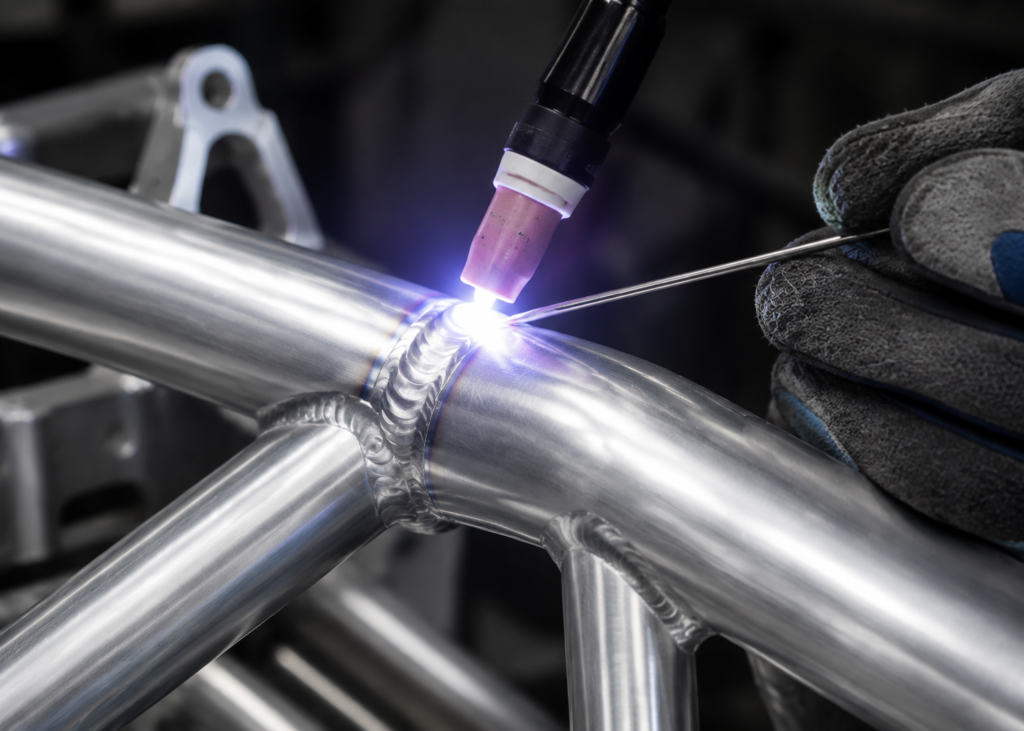
High Thermal Conductivity Increases Heat Control Difficulty
Aluminum transfers heat much faster than steel.
During welding, heat can quickly spread away from the weld area.
This creates challenges such as:
- Difficulty achieving proper penetration.
- Increased heat input requirements.
- Greater risk of deformation.
Experienced welders must carefully balance:
- Welding current.
- Travel speed.
- Heat distribution.
Too little heat may cause incomplete fusion.
Too much heat may distort the frame geometry.
Welding Deformation Can Affect Motorcycle Performance
Motorcycle frames require accurate geometry.
Important dimensions include:
- Steering head angle.
- Wheel alignment.
- Engine mounting position.
- Suspension mounting locations.
During aluminum welding, thermal expansion and contraction can create distortion.
Even small dimensional changes may influence:
- Handling stability.
- Steering response.
- Suspension performance.
Therefore, professional aluminum frame fabrication requires:
- Accurate welding fixtures.
- Controlled welding sequences.
- Proper clamping methods.
Aluminum Fatigue Performance Depends on Welding Quality
A common misunderstanding is that if an aluminum frame is strong enough initially, it will remain reliable.
However, motorcycle frames experience repeated loading during operation.
For example:
- Engine vibration.
- Road impacts.
- Cornering forces.
- Braking loads.
These repeated stresses can create fatigue problems around welded areas.
Potential fatigue-sensitive locations include:
- Weld toes.
- Tube junctions.
- Heat affected zones.
- Sudden geometry transitions.
A reliable aluminum motorcycle frame requires attention not only to weld appearance but also to long-term fatigue resistance.
Common Aluminum Motorcycle Frame Welding Defects and Their Risks
When evaluating an aluminum motorcycle frame supplier, buyers should understand common welding defects.
Porosity
Porosity occurs when gas becomes trapped inside the weld metal.
Possible causes include:
- Contaminated material.
- Improper shielding gas protection.
- Incorrect welding parameters.
Risks:
- Reduced fatigue strength.
- Lower joint reliability.
Lack of Fusion
Lack of fusion occurs when the weld metal does not properly bond with the base material.
Risks:
- Reduced load transfer capability.
- Potential structural failure under repeated stress.
Excessive Heat-Affected Zone
Too much heat input can affect the surrounding aluminum material.
Possible results:
- Reduced mechanical properties.
- Increased distortion.
- Lower fatigue resistance.
Cracks
Cracking is one of the most serious welding defects.
For aluminum alloys, crack prevention requires control of:
- Material selection.
- Welding parameters.
- Cooling conditions.
How Professional Manufacturers Control Aluminum Motorcycle Frame Quality
A reliable aluminum motorcycle frame is not produced by welding alone.
It requires complete process control.
Material Selection
Different aluminum alloys provide different performance characteristics.
Common considerations include:
- Strength requirements.
- Weldability.
- Fatigue performance.
- Application conditions.
The selected alloy should match the motorcycle design requirements.
Tube Preparation and Joint Accuracy
Before welding begins, proper preparation is essential.
Manufacturers need to control:
- Tube cutting accuracy.
- Joint fit-up.
- Contact surfaces.
Poor joint preparation may create welding defects even with skilled welders.
Welding Fixtures and Position Control
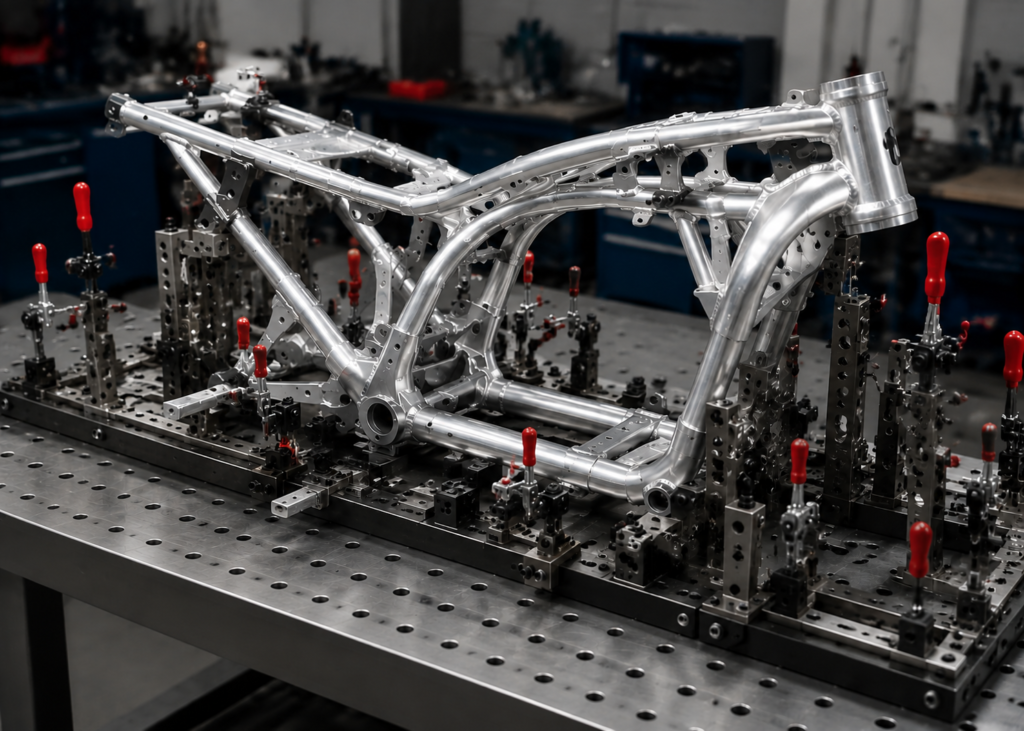
A professional aluminum frame manufacturer uses dedicated fixtures to maintain geometry during welding.
Fixtures help control:
- Frame alignment.
- Dimensional accuracy.
- Welding deformation.
This is especially important for performance motorcycles where small geometry changes can affect riding behavior.
Welding Sequence Optimization
Experienced welders understand that welding order influences final frame accuracy.
Improper welding sequences can create uneven thermal stress.
Professional processes often include:
- Symmetrical welding.
- Controlled heat distribution.
- Multiple inspection steps.
TIG Welding vs MIG Welding for Aluminum Motorcycle Frames
Different production requirements may require different welding methods.
TIG Welding Aluminum Motorcycle Frames
TIG welding is widely used for premium and custom aluminum motorcycle frames.
Advantages:
- Excellent heat control.
- Precise welding operation.
- High-quality weld appearance.
Suitable for:
- Custom motorcycle frames.
- Prototype development.
- Small-batch production.
However, TIG welding requires highly skilled operators because aluminum demands precise control.
MIG Welding Aluminum Motorcycle Frames
MIG welding can provide higher production efficiency.
Advantages:
- Faster welding speed.
- Suitable for larger production volumes.
- Stable production efficiency.
However, successful aluminum MIG welding still requires:
- Correct equipment setup.
- Proper parameter adjustment.
- Experienced operators.
Automation can improve consistency, but it cannot replace proper process design.
Questions Buyers Should Ask Before Choosing an Aluminum Motorcycle Frame Supplier
Before selecting a supplier, buyers should evaluate more than price and delivery time.
Consider asking:
Does the supplier understand aluminum welding challenges?
A capable supplier should explain:
- How they control heat input.
- How they prevent deformation.
- How they manage fatigue risks.
How do they maintain frame geometry after welding?
Ask about:
- Welding fixtures.
- Inspection methods.
- Dimensional control.
Do they focus only on weld appearance?
A professional manufacturer understands that:
Beautiful welds do not automatically mean reliable structures.
They should also consider:
- Penetration.
- Fatigue resistance.
- Material behavior.
Do they have experience with custom aluminum fabrication?
Custom aluminum motorcycle frames often require:
- Engineering communication.
- Flexible production capability.
- Problem-solving experience.
Conclusion: A Reliable Aluminum Motorcycle Frame Requires More Than Skilled Welding
An Aluminum Motorcycle Frame represents the combination of lightweight engineering, structural design, and advanced fabrication control.
The biggest challenges are not only creating a visible weld but controlling:
- Heat input.
- Welding deformation.
- Joint quality.
- Fatigue performance.
- Dimensional accuracy.
For motorcycle manufacturers and buyers, selecting the right supplier means choosing a partner who understands how aluminum behaves throughout the entire fabrication process.
A reliable aluminum motorcycle frame is not simply welded together — it is engineered, controlled, and manufactured with experience.