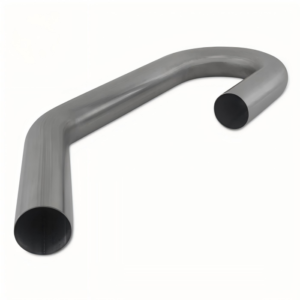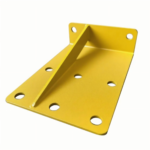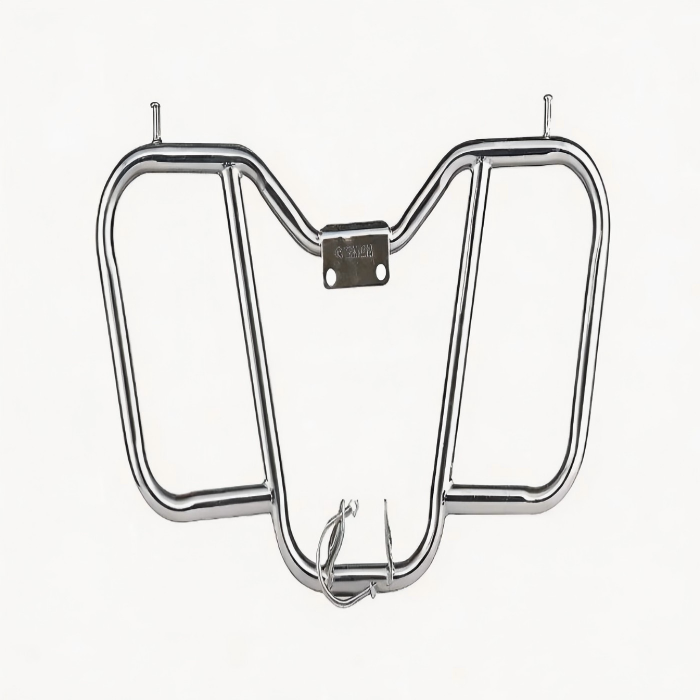
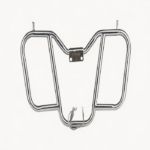
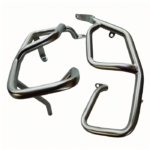
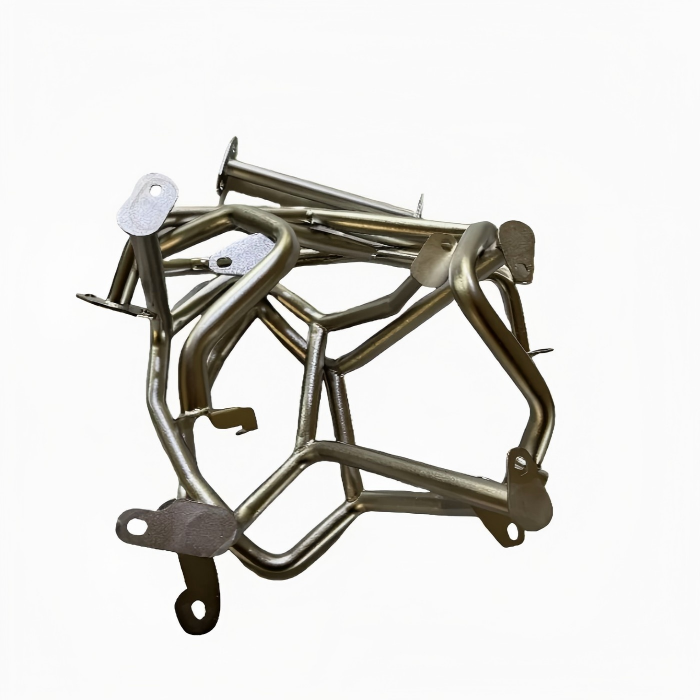
Barra anticaduta superiore per moto piegatura tubi protezione motore
Questa Barra Antiribaltamento per Motocicletta è fabbricata su misura con tecnologia di piegatura di precisione dei tubi e costruzione in acciaio verniciato a polvere.
Request a Quote
Enter the quantity you need and add to your quote list for pricing inquiries.
Product Details
Why Tube Bending Quality Defines a Crash Bar on Motorcycle?
A crash bar on motorcycle typically consists of two bent tubes left and right that mount to the engine cradle or frame downtubes. When the bike falls, the crash bar contacts the ground first, creating a protective gap between the road surface and the engine or the rider leg. This simple concept only works when the tube bends are accurate, structurally sound, and free from hidden defects.
.
Poorly executed bending creates three common failure modes. First, wrinkles or kinks on the inner bend radius act as stress risers. Under impact, the crack starts at the wrinkle and propagates through the tube. Second, inaccurate bend angles prevent proper alignment with frame mounting points. A crash bar on motorcycle that does not fit correctly will either leave dangerous gaps or require hammering during installation which damages the finish. Third, excessive wall thinning creates a weak spot that collapses earlier than the rest of the bar, causing unbalanced protection where one side fails while the other holds.
.
Precision tube bending eliminates all three problems. A professionally bent crash bar on motorcycle fits perfectly, absorbs impact evenly, and survives multiple falls without cracking.
.

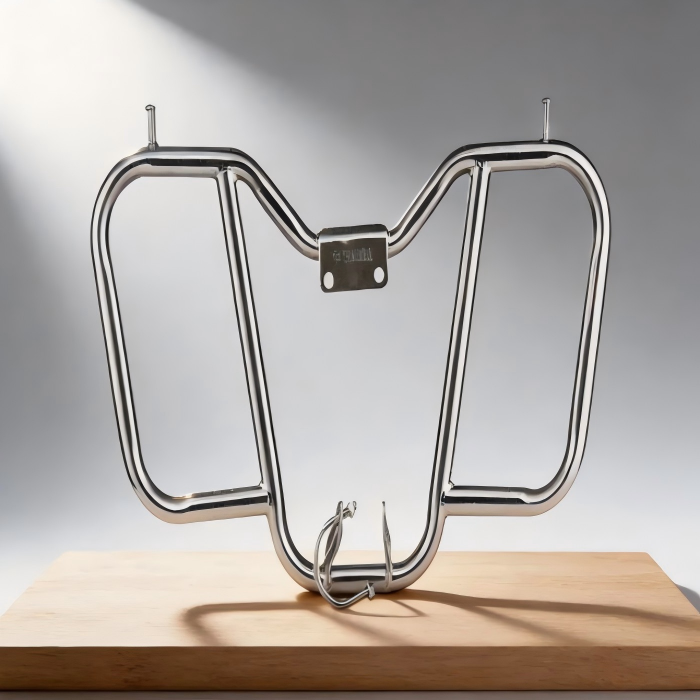
Best Tube Bending Methods for a Crash Bar on Motorcycle:
Different crash bar designs require different bending approaches. As a tube bending service provider, you should guide your clients toward the most suitable method based on their design complexity, volume, and budget.
.
Mandrel bending is the gold standard for any visible crash bar on motorcycle. Because crash bars are often finished with chrome plating or powder coating, any internal wrinkling or surface marking becomes immediately visible. A flexible mandrel inserted inside the tube during bending supports the inner wall, preventing ovality and collapse. This method is essential when the crash bar has tight radii such as the curve that wraps around a protruding engine cover or cylinder head.
.
Rotary draw bending without a mandrel works for larger radius bends or heavier wall tubes where slight ovality is acceptable. For a budget friendly crash bar on motorcycle aimed at entry level riders, this method reduces tooling cost but should never be used for radii tighter than three times the tube diameter.
.
CNC bending is non negotiable for symmetrical left and right crash bars. Manual bending almost always introduces human error, resulting in a mismatched crash bar on motorcycle that looks asymmetrical and mounts poorly. CNC programming guarantees repeatability across hundreds or thousands of units with left and right sides mirrored perfectly.
.
Critical Design Specifications for Crash Bar on Motorcycle Tube Bending:
To deliver a superior crash bar on motorcycle, your engineering team must control several parameters with precision.
.
Tube diameter and wall thickness are the first decisions. Most crash bars use 1 inch to 1.25 inch OD tubing. Wall thickness typically ranges from 0.095 inches for lightweight adventure bikes to 0.120 inches for heavy cruisers or touring motorcycles. Thinner walls reduce weight but collapse more easily. Thicker walls offer better protection but add unsprung mass. Your role is to help clients select the optimal balance for their target motorcycle model and weight class.
.
Bend radius determines how tightly the crash bar on motorcycle can wrap around engine components. The minimum centerline bend radius for most applications is 2 inches to 3 inches. With mandrel bending, radii as tight as 1.5 times the tube diameter are achievable without wrinkling. For reference, a 1 inch OD tube can be bent to a 1.5 inch centerline radius on a high quality CNC mandrel bender.
.
Wall thinning allowance is a critical safety parameter. During bending, the outer wall stretches and becomes thinner. For a crash bar on motorcycle that must pass real world impact tests, wall thinning should not exceed 12 percent of the original thickness. Exceeding this limit creates a weak spot that will deform or crack first during a crash, defeating the purpose of the protection.
.
Springback compensation ensures final angles match the design. Steel tubes spring back slightly after bending. A precision bending service calculates springback in advance and over bends the tube by 1 to 2 degrees. Without this compensation, the final crash bar on motorcycle will have open angles that fail to mate flush against the engine cradle.
.
Material Selection for Crash Bar on Motorcycle:
The choice of material directly affects bending difficulty, final weight, corrosion resistance, and cost. Each material has a place in the market.
.
Mild steel is the most common material for a crash bar on motorcycle. It bends easily, welds well, and accepts chrome plating or powder coating without issue. AISI 1020 or 1026 DOM tube is preferred because it has no internal weld seam that could split during bending. DOM stands for drawn over mandrel, which means the tube already has a smooth interior surface and consistent wall thickness.
.
Stainless steel offers excellent corrosion resistance and a premium appearance that never rusts. However, stainless steel work hardens during bending, requiring higher tonnage and more frequent tooling changes. A crash bar on motorcycle made from 304 stainless will last longer in wet or salty environments but costs more to produce and takes longer to bend.
.
Aluminum is occasionally used for lightweight adventure bike crash bars where weight savings matter more than ultimate impact resistance. 6061 aluminum bends reasonably well with mandrel support but has lower impact resistance than steel. Aluminum crash bars are often larger in diameter to compensate for the material weakness, which can create clearance issues on some motorcycles.
.
Operazioni secondarie per una barra anticaduta completa su motocicletta
Il tuo servizio di piegatura tubi può aggiungere un valore significativo offrendo operazioni secondarie che fanno risparmiare tempo e denaro ai clienti. Questi servizi ti rendono anche un punto di riferimento unico, non solo un piegatore.
La tacca laser crea estremità copiate precise che si adattano ai tubi del telaio senza spazi vuoti. Una tacca pulita migliora la resistenza della saldatura e l'aspetto. La tacca manuale con una smerigliatrice è lenta, incoerente e pericolosa.
La punzonatura CNC aggiunge fori di montaggio in posizioni e angoli esatti. Questo elimina la necessità per i clienti di forare i fori da soli, cosa che spesso porta a disallineamenti e finiture danneggiate.
La formatura delle estremità riduce o espande l'estremità del tubo per adattarsi a una presa di accoppiamento o a una staffa del telaio. Questo è comune quando la barra anticaduta per moto utilizza hardware di montaggio a presa.
La sbavatura e la pulizia rimuovono bordi taglienti e residui di liquido di taglio prima della finitura. Nessun cliente vuole tagliarsi le mani su una bava durante l'installazione.
Conclusione:
Una barra anticaduta per moto è valida quanto le pieghe che la modellano. Ogni ruga, ogni angolo non corrispondente e ogni punto di assottigliamento irregolare della parete rappresenta un potenziale cedimento durante un incidente reale. Fornendo tubi piegati con mandrino di precisione con tolleranze strette e superfici pulite, il tuo servizio di piegatura tubi trasforma un semplice componente metallico in una vera protezione per il pilota. È così che costruisci partnership a lungo termine con marchi che tengono alla qualità.
Domande frequenti sulla piegatura dei tubi per barra anticaduta per moto:
Quale spessore di parete consigli per una barra anticaduta per moto?
Consigliamo 0,095 pollici per moto da avventura leggere e 0,120 pollici per cruiser pesanti o moto da turismo che utilizzano acciaio DOM.
Puoi piegare un tubo con diametro esterno di 1,25 pollici per il mio ordine di barra anticaduta per moto?
Sì, la nostra piegatrice CNC a mandrino gestisce tubi con diametro esterno da 0,75 a 2 pollici con ovalità inferiore all'8% e senza rughe.
Qual è il raggio di piegatura minimo per il telaio principale di una barra anticaduta per moto?
Il nostro raggio minimo sulla linea centrale è 1,5 volte il diametro del tubo. Per un tubo con diametro esterno di 1 pollice, equivale a un raggio di 1,5 pollici.
Offrite prototipazione per una barra anticaduta per moto prima della produzione di massa?
Sì, offriamo prototipazione a basso volume da una a cinque unità per test di adattamento prima di passare alla produzione completa.
Come prevenite il collasso del tubo quando piegate raggi stretti per una barra anticaduta per moto?
Utilizziamo un mandrino rettificato di precisione, una matrice di strippaggio e una matrice di pressione per sostenere la parete interna del tubo durante la piegatura.