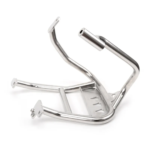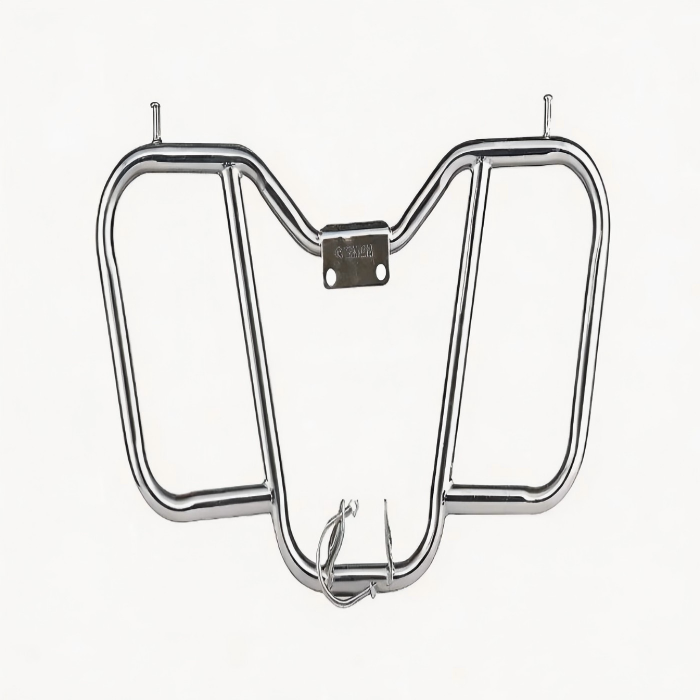
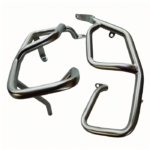
Barra de Protección Superior en Curvado de Tubos para Motocicleta Guardabarros Protector del Motor
Esta barra antivuelco para motocicleta está fabricada a medida con tecnología de doblado de tubos de precisión y construcción de acero recubierto en polvo.
Request a Quote
Enter the quantity you need and add to your quote list for pricing inquiries.
Product Details
Why Tube Bending Quality Defines a Crash Bar on Motorcycle?
A crash bar on motorcycle typically consists of two bent tubes left and right that mount to the engine cradle or frame downtubes. When the bike falls, the crash bar contacts the ground first, creating a protective gap between the road surface and the engine or the rider leg. This simple concept only works when the tube bends are accurate, structurally sound, and free from hidden defects.
.
Poorly executed bending creates three common failure modes. First, wrinkles or kinks on the inner bend radius act as stress risers. Under impact, the crack starts at the wrinkle and propagates through the tube. Second, inaccurate bend angles prevent proper alignment with frame mounting points. A crash bar on motorcycle that does not fit correctly will either leave dangerous gaps or require hammering during installation which damages the finish. Third, excessive wall thinning creates a weak spot that collapses earlier than the rest of the bar, causing unbalanced protection where one side fails while the other holds.
.
Precision tube bending eliminates all three problems. A professionally bent crash bar on motorcycle fits perfectly, absorbs impact evenly, and survives multiple falls without cracking.
.

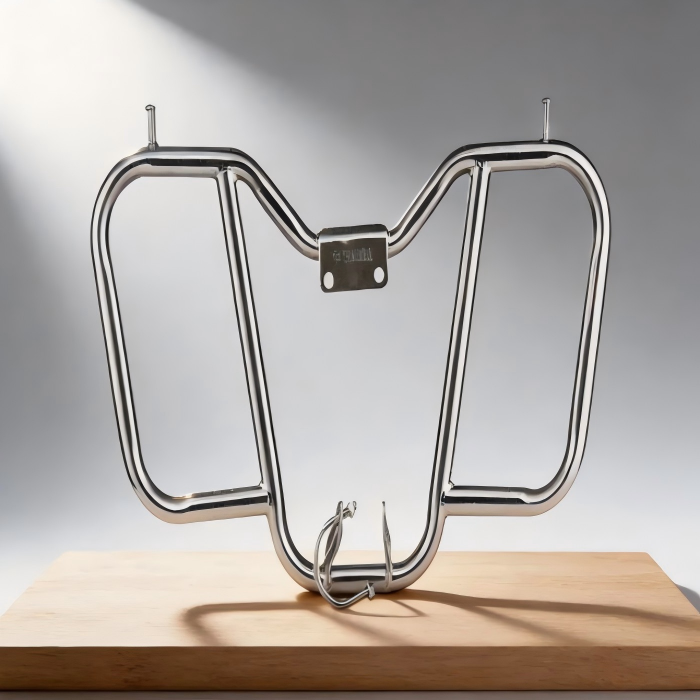
Best Tube Bending Methods for a Crash Bar on Motorcycle:
Different crash bar designs require different bending approaches. As a tube bending service provider, you should guide your clients toward the most suitable method based on their design complexity, volume, and budget.
.
Mandrel bending is the gold standard for any visible crash bar on motorcycle. Because crash bars are often finished with chrome plating or powder coating, any internal wrinkling or surface marking becomes immediately visible. A flexible mandrel inserted inside the tube during bending supports the inner wall, preventing ovality and collapse. This method is essential when the crash bar has tight radii such as the curve that wraps around a protruding engine cover or cylinder head.
.
Rotary draw bending without a mandrel works for larger radius bends or heavier wall tubes where slight ovality is acceptable. For a budget friendly crash bar on motorcycle aimed at entry level riders, this method reduces tooling cost but should never be used for radii tighter than three times the tube diameter.
.
CNC bending is non negotiable for symmetrical left and right crash bars. Manual bending almost always introduces human error, resulting in a mismatched crash bar on motorcycle that looks asymmetrical and mounts poorly. CNC programming guarantees repeatability across hundreds or thousands of units with left and right sides mirrored perfectly.
.
Critical Design Specifications for Crash Bar on Motorcycle Tube Bending:
To deliver a superior crash bar on motorcycle, your engineering team must control several parameters with precision.
.
Tube diameter and wall thickness are the first decisions. Most crash bars use 1 inch to 1.25 inch OD tubing. Wall thickness typically ranges from 0.095 inches for lightweight adventure bikes to 0.120 inches for heavy cruisers or touring motorcycles. Thinner walls reduce weight but collapse more easily. Thicker walls offer better protection but add unsprung mass. Your role is to help clients select the optimal balance for their target motorcycle model and weight class.
.
Bend radius determines how tightly the crash bar on motorcycle can wrap around engine components. The minimum centerline bend radius for most applications is 2 inches to 3 inches. With mandrel bending, radii as tight as 1.5 times the tube diameter are achievable without wrinkling. For reference, a 1 inch OD tube can be bent to a 1.5 inch centerline radius on a high quality CNC mandrel bender.
.
Wall thinning allowance is a critical safety parameter. During bending, the outer wall stretches and becomes thinner. For a crash bar on motorcycle that must pass real world impact tests, wall thinning should not exceed 12 percent of the original thickness. Exceeding this limit creates a weak spot that will deform or crack first during a crash, defeating the purpose of the protection.
.
Springback compensation ensures final angles match the design. Steel tubes spring back slightly after bending. A precision bending service calculates springback in advance and over bends the tube by 1 to 2 degrees. Without this compensation, the final crash bar on motorcycle will have open angles that fail to mate flush against the engine cradle.
.
Material Selection for Crash Bar on Motorcycle:
The choice of material directly affects bending difficulty, final weight, corrosion resistance, and cost. Each material has a place in the market.
.
Mild steel is the most common material for a crash bar on motorcycle. It bends easily, welds well, and accepts chrome plating or powder coating without issue. AISI 1020 or 1026 DOM tube is preferred because it has no internal weld seam that could split during bending. DOM stands for drawn over mandrel, which means the tube already has a smooth interior surface and consistent wall thickness.
.
Stainless steel offers excellent corrosion resistance and a premium appearance that never rusts. However, stainless steel work hardens during bending, requiring higher tonnage and more frequent tooling changes. A crash bar on motorcycle made from 304 stainless will last longer in wet or salty environments but costs more to produce and takes longer to bend.
.
Aluminum is occasionally used for lightweight adventure bike crash bars where weight savings matter more than ultimate impact resistance. 6061 aluminum bends reasonably well with mandrel support but has lower impact resistance than steel. Aluminum crash bars are often larger in diameter to compensate for the material weakness, which can create clearance issues on some motorcycles.
.
Operaciones Secundarias para una Barra Antivuelco Completa en Motocicleta:
Su servicio de doblado de tubos puede agregar un valor significativo al ofrecer operaciones secundarias que ahorran tiempo y dinero a los clientes. Estos servicios también lo convierten en un centro integral en lugar de solo un doblador.
El ranurado con láser crea extremos copiados precisos que se ajustan contra los tubos del marco sin espacios. Un ranurado limpio mejora la resistencia de la soldadura y la apariencia. El ranurado manual con una amoladora es lento, inconsistente y peligroso.
El punzonado CNC agrega orificios de montaje en ubicaciones y ángulos exactos. Esto elimina la necesidad de que los clientes taladren agujeros ellos mismos, lo que a menudo provoca desalineación y daños en el acabado.
El conformado de extremos reduce o expande el extremo del tubo para que encaje en un zócalo de acoplamiento o soporte del marco. Esto es común cuando el crash bar en la motocicleta utiliza herrajes de montaje tipo zócalo.
El desbarbado y la limpieza eliminan los bordes afilados y los residuos del fluido de corte antes del acabado. Ningún cliente quiere cortarse las manos con una rebaba durante la instalación.
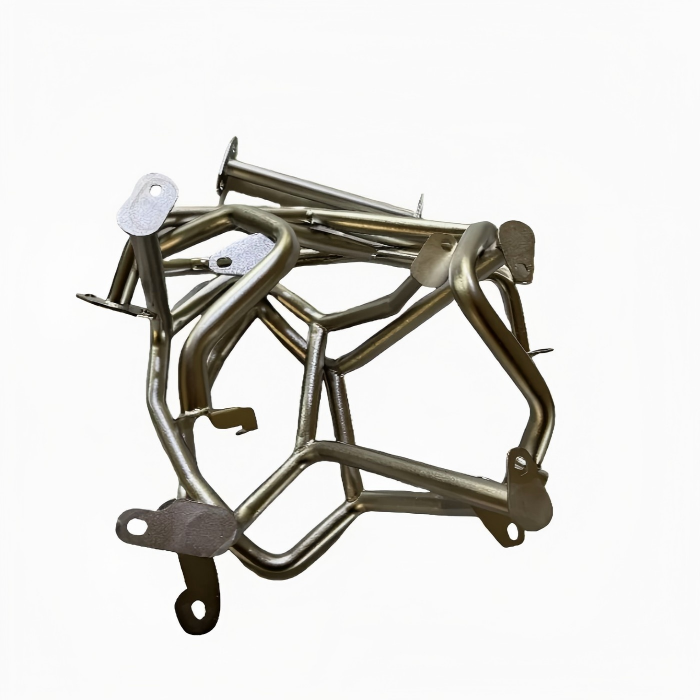
Conclusión:
Un crash bar en la motocicleta es tan bueno como los dobleces que lo forman. Cada arruga, cada ángulo desajustado y cada punto de adelgazamiento desigual de la pared representa una falla potencial durante un accidente real. Al entregar tubos doblados con mandril de precisión con tolerancias ajustadas y superficies limpias, su servicio de doblado de tubos transforma una simple pieza metálica en una protección genuina para el conductor. Así es como se construyen asociaciones a largo plazo con marcas que se preocupan por la calidad.
Preguntas frecuentes sobre el doblado de tubos para crash bar en motocicleta:
¿Qué espesor de pared recomienda para un crash bar en motocicleta?
Recomendamos 0.095 pulgadas para motos de aventura ligeras y 0.120 pulgadas para cruceros pesados o motocicletas de turismo que utilizan acero DOM.
¿Puede doblar un tubo de 1.25 pulgadas de diámetro exterior para mi pedido de crash bar en motocicleta?
Sí, nuestra dobladora de mandril CNC maneja tubos de 0.75 a 2 pulgadas de diámetro exterior con menos del 8 por ciento de ovalidad y sin arrugas.
¿Cuál es el radio de curvatura mínimo para el aro principal de un crash bar en motocicleta?
Nuestro radio de línea central mínimo es 1.5 veces el diámetro del tubo. Para un tubo de 1 pulgada de diámetro exterior, eso equivale a un radio de 1.5 pulgadas.
¿Ofrecen creación de prototipos para un crash bar en motocicleta antes de la producción en masa?
Sí, ofrecemos creación de prototipos de bajo volumen de una a cinco unidades para pruebas de ajuste antes de escalar a producción completa.
¿Cómo evitan el colapso del tubo al doblar radios ajustados para un crash bar en motocicleta?
Utilizamos un mandril rectificado de precisión, un troquel limpiador y un troquel de presión para soportar la pared interior del tubo durante el doblado.